
In the field of advanced material characterization, reliable thermophysical data at extreme temperatures is a decisive advantage. Yet for decades, laboratories and industrial facilities attempting high temperature viscosity measurement above 1,600°C have faced the same fundamental obstacle — the moment a molten sample contacts a crucible or measurement vessel, the integrity of that data is compromised.
We are currently redefining what is possible in high temperature viscometry. With ViscoDrop, our containerless high temperature viscometer, we have eliminated the crucible from the measurement process entirely — and with it, every contamination pathway that has limited the reliability of viscosity data at extreme temperatures.
The Fundamental Limitation of Crucible-Based Viscometry
In the field of high temperature measurement, the crucible has always represented both a necessity and a liability. Conventional rotational and capillary viscometers require the sample to be contained in a vessel — typically fabricated from alumina, zirconia, graphite, or platinum — during the measurement process.
At moderate temperatures, this approach delivers acceptable results. However, as temperatures rise above 1,400°C, the chemical environment changes dramatically. Molten metals and oxide melts become highly aggressive at extreme temperatures, reacting with the very containers designed to hold them. Alumina and zirconia crucibles partially dissolve into silicate and oxide melts, fundamentally altering melt composition and producing erroneous viscosity readings. Graphite crucibles introduce carbon into metallic melts, changing alloy chemistry in ways that cannot be corrected after the fact. Even platinum — the gold standard for moderate-temperature containment — reacts with transition metal melts above 1,500°C.
Furthermore, the physical presence of a container introduces wall effects, wetting interactions, and surface tension artifacts that distort the true rheological behavior of the melt. The harder one pushes toward higher temperatures, the more severe these effects become. Above 1,600°C, obtaining reliable viscosity data from a contact-based viscometer is, in practice, nearly impossible.
The ViscoDrop Approach: Containerless Measurement
ViscoDrop technology offers a revolutionary approach to high temperature viscosity measurement. We utilize the principle of non-contact measurement — suspending the sample as a free-floating droplet using precisely controlled aerodynamic forces, so that the melt never touches any solid surface throughout the entire measurement process.
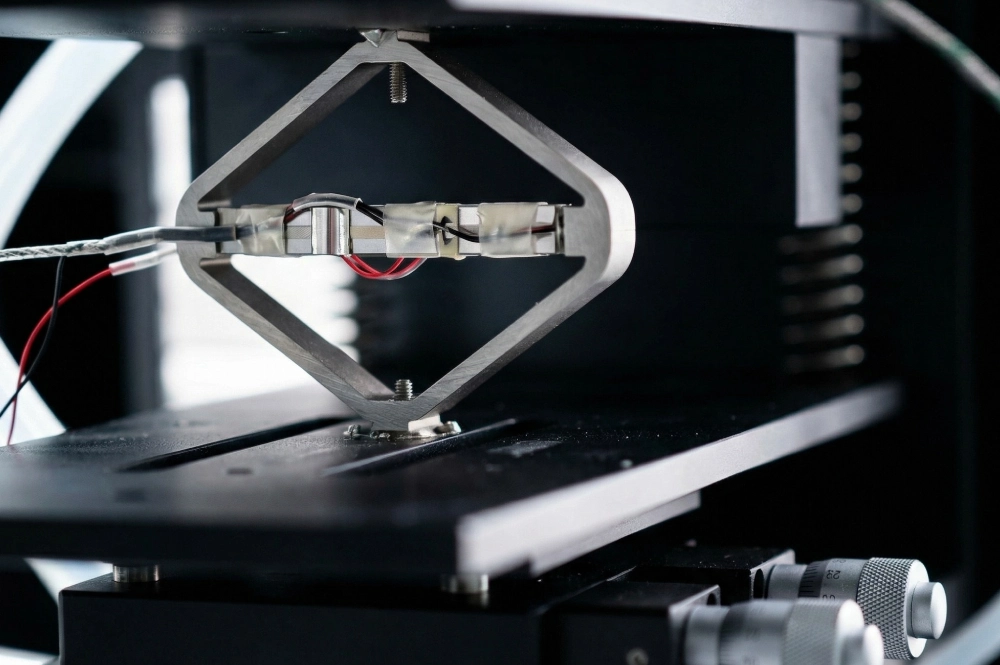
A vertical actuator moves toward the suspended sample and induces a controlled deformation without ever touching the fluid. The induction force is then suddenly removed. The droplet relaxes freely to regain its natural spherical shape. We capture the full oscillation decay curve using high-speed imaging, and from this curve we extract viscosity, surface tension, and contact angle simultaneously — providing a complete thermophysical dataset from a single measurement event.
This process operates across a full thermal range of 300°C to 2,200°C. In this way, we eliminate every contamination pathway that has historically compromised high temperature viscosity data — and deliver results that reflect the true physics of the molten material, unaffected by crucible chemistry or wall interactions.
Materials Accessible Through Containerless High Temperature Viscometry
A core innovation of our technology lies in the breadth of materials it makes accessible. Traditional viscometers usually require many milliliters of material and are limited to temperature ranges where crucible integrity can still be maintained. ViscoDrop, by contrast, measures critical parameters using only a few microliters of material — and does so across a temperature range that conventional instruments cannot approach.
Nickel-based superalloys such as Inconel 718 and René 80 — materials at the heart of aerospace turbine blade manufacturing — can be characterized at temperatures spanning their full liquidus range without any risk of titanium, aluminum, or zirconium contamination from crucible reactions. Cobalt-based superalloys, refractory metals including tungsten and molybdenum, oxide and silicate melts, high-entropy alloys, and nuclear materials can all be measured with the same degree of confidence and repeatability that ViscoDrop delivers across its entire operating range.
Practical Advantages for Research and Industrial Environments
This instrument delivers high-precision results for both cutting-edge laboratories and heavy industries. In addition to eliminating contamination, ViscoDrop captures viscosity, surface tension, and contact angle simultaneously — a breakthrough that delivers tangible benefits for modern production facilities and research environments alike.
Laboratories working with experimental alloy compositions, isotopically labelled samples, or precious metal systems benefit particularly from ViscoDrop’s microliter sample requirement, which dramatically reduces both material costs and preparation time per measurement. Furthermore, because the sample never contacts a vessel, there is no gradual contamination of the measurement system between experimental runs — calibration stability is maintained across entire measurement campaigns without the drift that plagues conventional high temperature viscometers.
Applications Across Industries
The need for reliable high temperature viscosity data above 1,600°C spans multiple industries. Aerospace research and development laboratories rely on accurate melt characterization for turbine blade casting optimization and next-generation superalloy development. Steel and metallurgy operations depend on precise slag viscosity data for continuous casting and blast furnace process control. Glass manufacturers require reliable molten silicate characterization during forming and fining operations. Nuclear research institutes studying corium and oxide melt behavior for reactor safety analysis benefit from ViscoDrop’s containment-free measurement approach, which eliminates sample handling risks at extreme temperatures.
In each of these fields, the shift from crucible-based to containerless high temperature viscosity measurement represents more than a technical improvement — it is a fundamental advance in data quality and scientific reliability.
FAQ: High Temperature Viscosity Measurement
Q: What is the operating temperature range of ViscoDrop?
ViscoDrop operates across a full thermal range of 300°C to 2,200°C, making it suitable for virtually all industrially and scientifically relevant high temperature melts, including refractory metals and complex oxide systems.
Q: How does the containerless approach eliminate crucible contamination?
By levitating the sample droplet using aerodynamic forces, ViscoDrop ensures the melt never contacts any solid surface during the measurement process. There is no crucible, no spindle, and no vessel wall — and therefore no contamination pathway of any kind.
Q: Can ViscoDrop measure both metallic and non-metallic melts?
Yes. ViscoDrop is designed for both metallic melts — including superalloys, refractory metals, and reactive metal systems — and non-metallic melts such as silicates, aluminates, oxide slags, and glass systems across its full operating range.
Q: How much material is required for a measurement?
ViscoDrop measures critical parameters using only a few microliters of material — a fraction of the sample volume required by conventional viscometers — making it practical for experimental alloys, precious metals, and isotopically labelled materials.
Q: Can the measurement atmosphere be controlled for reactive samples?
Yes. The levitation gas atmosphere can be precisely controlled, including the use of inert gases such as argon or helium, to prevent oxidation of reactive samples throughout the measurement process.